
The 5X5 Program

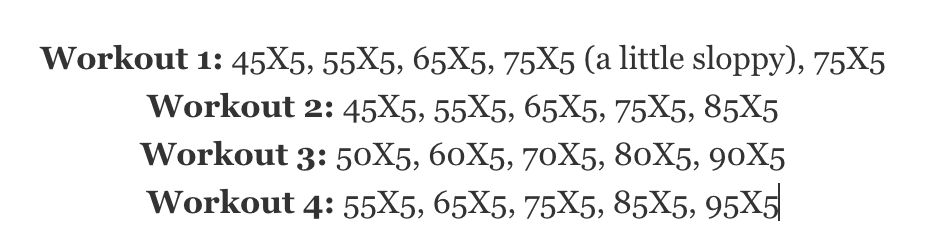
In this article I want to look briefly at the history of the 5X5 program as well as at some of the various interpretations that have been used over the years. One source of confusion comes in that there are so many different ways to interpret 5X5 (depending on the goals and status of the lifter) and just saying that you’re doing ‘5X5’ doesn’t really give all of the details.

Ketogenic Low-Carbohydrate Diets have no Metabolic Advantage over Nonketogenic Low-Carbohydrate Diets – Research Review

Now, before I continue let me say that I have nothing against low-carbohydrate diets. My first book The Ketogenic Diet was about nothing but and many of my dietary approaches often have low- or at least lowered carbohydrate phases to them. Research clearly shows that, for some people, lowering carbohydrates can have profound health benefits and in some cases a near removal of dietary carbohydrates (except for things like fruits and vegetables) may be profoundly beneficial.

Body Composition Recommendations

Finally, in this article, I want to give some concrete recommendations on how to put this information to use, with some specific recommendations about measuring and tracking body composition. First off I want to discuss one last potential problem with body composition measurements; then I’ll make some specific recommendations about which methods to use, when to measure body composition and how best to make use of the information I’ve presented.

Squat vs. Leg Press for Big Legs

First and foremost, while I’m sure my answer will offend the hardcore/hardheaded lifters but there is no requirement to perform squat to build big legs (or even build leg strength). I know that this contradicts everything that has ever been written on the Internet but the idea that someone must squat to get big is just macho nonsense.

Problems with Measuring Body Composition

Today, I want to back up a bit and get a little more technical and look at some of the problems inherent to tracking body composition accurately. This will lead me to finally round out this series by giving some specific recommendations on how to use the various methods to get the best measure of what’s going on.

Energy Density

Conceptually, energy density refers to how many calories are found in a given weight or volume or food. Ok, what does that mean. Let’s say that you have 1 gram of each of the three macronutrients which are protein, carbohydrates and fat. We know that these are given calorie values of 4 cal/g for protein and carbs and 9 cal/g for fat. Clearly, in this simple example, fat has over twice the energy density of either carbs or fat (9 cal in one gram vs. 4 cal in one gram).

Hormonal Responses to a Fast-Food Meal – Research Review

Fundamentally, my belief is that, given identical macro-nutrient intakes (in terms of protein, carbs, and fats) that there is going to be little difference in terms of bodily response to a given meal. There may be small differences mind you (and of course research supports that) but, overall, they are not large. And certainly not of the magnitude that many make it sound like.

Maximal Strength Training for Bodybuilders – Q&A

It’s hard for one to get bigger when their strength is the limiting factor. Eric Cressey once used an analogy of a cup with water in it. The water inside is your size, speed, endurance etc. but eventually the cup gets full and the only thing you can do to really progress is to increase the size of the glass – maximal strength.

Measuring Body Composition: Part 2

Today, I want to look at methods, some of which will be repeated from Wednesday, that allow actual tracking of changes in true body composition. That is, they can be used (to some degree anyhow) to estimate actual body fat composition which can then be used, using the method in Body Composition Calculations, to determine actual fat and lean body mass and track changes.

Measuring Body Composition: Part 1

Over the next two articles, I want to look at various methods of determining ‘body composition’ (you’ll understand why I’m putting that in quotations in a second) that are available. These range from low- to high-tech and from extremely useful to useless (or at least impractical).

Next Page »